Showing posts with label Death. Show all posts

Thursday, 17 October 2013

one single moment of truth


'Close some doors today. Not because of pride, incapacity or arrogance, but simply 
because they led you nowhere.'
- Paul Coelho

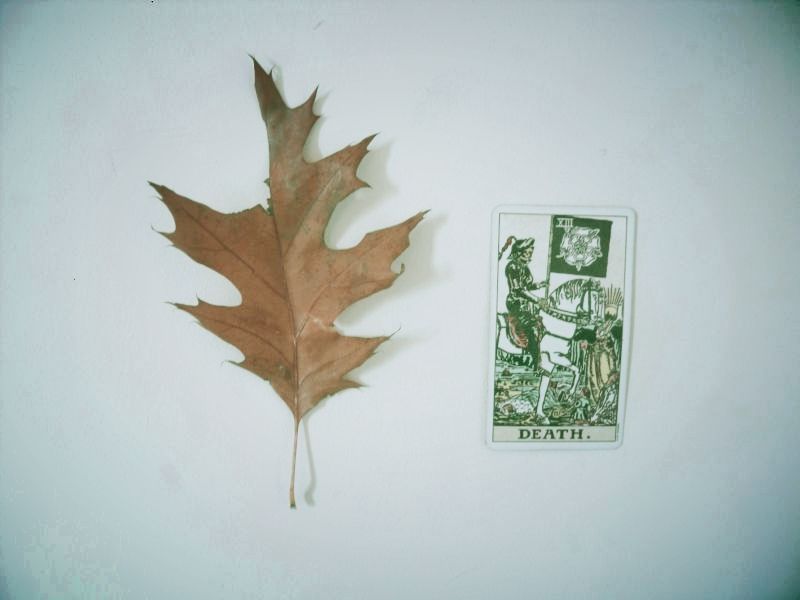
Shadow work and release work can be relevant and necessary at any time, but for those entering the dark half of the year, they seem to visit effortlessly. Some things just make sense. As leaves cover the land and death shows its true, cold beauty, 'farewell' is the mantra. Even when we've tried to hold it at bay through the summer, the winter lets it slip from between white teeth. Let's really grasp hold of this time. 

A few days ago I closed a door in my life which had been open for almost a decade. I knew that its closure would lead to a release which couldn't be reached in any other way. I needed 'goodbye' like I needed air and, finally, I surrendered. Your 'goodbye' won't always be welcomed with grace and understanding. Sometimes it will be scoffed at, ridiculed or resented bitterly. Sometimes people will tell you that you're mad or that you're just being needlessly destructive. Some people will look at you with some vague trace of fear behind their eyes as you rock the boat and jump for shore. You must stand strong. You must love yourself and know yourself enough to give yourself the gift of release, even against naysaying, even against intense fear of loneliness and even against the trembling of the ego. These moments are the ones which weave the fabric of a life. 

The status quo is something we constantly reassess and readjust to. Sometimes we're going steady and sometimes we're suffocating. It's hard to work out whether you're being brave or foolish when you finally recognise that the status quo is untenable. Maybe it's safe, even if it's hell. Maybe it's warm and familiar. Maybe it's easy. But you know it's not right. That knowing is your wild self gripping onto the bars and shaking them. Its protestations won't stop; not until you listen.

What are your strong foundations? What do you know for sure? Who are you when you're raw, stripped back, passionate, at one with the creative process? Who are you when everything and everyone else fades into the distance and it's just you, the darkness and one single moment of truth? 

You are stronger than you can even envision. 'Farewell' is so often followed by 'welcome'. Through letting go, you finally allow.

Sunday, 14 October 2012

a beginner's guide to surfing

I've said it before and I'll say it again (and again), Death is the most important card in Tarot when it comes to the subject of change. Change is inevitable and unavoidable, but it can also be traumatising, disconcerting and loathed on too many levels to count. The kind of change we can comfortably instigate and adequately prepare for is the kind that fills us with a sense of purpose and control. No problem. That's the kind of change we can all handle. But the kind of change that comes out of absolutely nowhere on an unremarkable weekday, just as it seemed that life was a calm, flat sea with no surprises in store - that's the kind of change that leaves us floored, unsure, totally terrified. Change only leaves permanent damage if we don't yield to it and move with it. If trees couldn't bend with the wind, there would be a lot less of them still rooted to the earth! They'd be blown away, unable to sustain themselves against the strength of the elements. Human beings are the same. If we refuse to bend with the inevitable and sometimes inhospitable nature of our ever-changing environment, we're toast.

Let's consider surfing as a metaphor. (Humour me.) Predicting the ebb and flow of the water is possible up to a certain point. Experience dictates that a surfer will be able to foresee how a certain, often observed pattern is likely to unfold. As the surfer gains confidence, they can move with the tide and make it look ridiculously easy. Getting to that stage is the result of incredible effort and the benefit of many mistakes. Death is a card that will hold your hand through your attempts to roll with the punches and let the surf take you. Eventually, once you've learned how to adapt quickly to unforeseen change, you will begin to trust yourself and will spend more time with your head above water than flailing for your life beneath the waves.

Paddling
One of the first things a surfing newbie will learn is how to paddle. This involves lying down on the board and turning it left and right with your arms on the water. Paddling belly-down on the board allows you to feel the movement of the water and get used to the idea of surfing.If you're a micromanager who enjoys a notably tight control over every aspect of your life, it may be beneficial for you to break with your own habits by instigating small changes to your schedule first of all in an effort to see change as a friend rather than an enemy. Introduce the occasional spontaneous break from routine. See time as something that organises and punctuates, rather than something that rules and dominates. Use time to pack more in, rather than to filter more out, which is what you're doing when you're trying to stick doggedly to a plan and avoid any surprises or unexpected stimuli. Learning not to sweat the small stuff means that when the big stuff comes along, you're much more equipped to handle it with poise. Learning to 'paddle' in this way means you can put strategies in place to deal with unexpected change. When I was younger I never realised I was a bit of a control freak. I was liberal, verbose and extroverted in many ways, so I thought of myself as a free spirit. It was only when a boyfriend of mine mentioned how irritated and disappointed I tended to be when things didn't go exactly to plan that I realised I was one of those people who couldn't be flexible. I allowed myself to be ruled by my expectations, and I hadn't even realised it! That's when I started 'paddling'. I'd give myself little chances to take a different road or let the day go in the opposite direction to the one I'd planned and imagined.

Duck Diving
This is the art of avoiding the break of a big wave when paddling by diving beneath it on your surf board just as it's crashing. This ensures that your body is not beaten back by the force of every breaking wave, but instead smoothly glides beneath and emerges on the other side. This is where you start to get clever. Change can feel destructive, disruptive and unfair when it messes up your plans, breaks your heart or seems to leave you high and dry. Disappointment is part of the process with anything that puts a spanner in the works, but dealing well with change is about moving beyond that disappointment and valuing the lesson that the change has offered. Each time something fails to go your way or there are unexpected situations to deal with, you could act as though a wave just smacked you straight in the face. You could let the ups and downs of life beat you up and do nothing but complain about them. Or, you could duck dive. Allow the change to roll over you, make the effort to adapt to it so that you can continue on your path without feeling too dishevelled and weary. When you see chaos coming your way, consider for a second what the most dynamic and stress-free way of dealing with it really is. Trying to swim away from it? Letting it smash you against the rocks? Freezing from fear? No - dive in head first, make your body and mind adapt to the natural, unpredictable flow of things. In this way, you become one with all that surrounds you. The course of life is no longer your enemy or something that's separate from you and out to inconvenience you. Only when you learn from change do you emerge on the other side of it. If you only ever let it hurt you or hold you back, you're never going to get where you want to go. It's all about perception.

Standing up
Once you've become accustomed to the mental strategies you can put in place to deal with change in a healthy way and learn from its power, you can really start to live your life with more confidence. This is the part where you begin to stand up on the board and dare to catch those big waves. You begin to view change as a challenge, not a disaster. You toughen up. This doesn't mean you don't feel disappointment when you fail to take a wave or do a trick and instead hit the water with a graceless thud. Of course you'll be disappointed, but you'll use hindsight to your advantage, looking at what went wrong and what to improve upon next time. Mastering the art of living means accepting and adapting to change whilst not losing your inner strength, stability and belief in your right to succeed, to heal and to be who you are. Once you're on your feet you know that you have a strong base from which to go on your travels and improve your skills. Self-respect that comes as the result of knowing you've gotten better at the art of living is a beautiful thing. When you're miles from the shore, you can look back and see just how far you've come.

Happy surfing!

Sunday, 11 September 2011

a deeper look at death

It's appropriate that Death is the first card I ever wrote about on this blog. Endings make up 50% of the meat on the bones of this card - beginnings are the other 50%. In the last Death post I approached the wonderful way this card warns us not to succumb to rigidity and denial. Letting go is part of the overall process of living and digging our heels in at the crossroads isn't going to help anyone, least of all ourselves. Once the card's most basic premise has been understood it's often natural for it to generate a lot of questions and opportunities for thought. This is why it's one of the best cards for visualisation work. You never quite know where it's going to lead you but it'll always be somewhere useful and beautiful.

Take the Death card from your working deck and pay special attention to its image and symbols. What feelings does it immediately conjure up? Is it supposed to be frightening and foreboding or does the image lend itself to a more soothing, spiritual interpretation? If you have several decks it might be worth looking at the differences between them and deciding which one you prefer. Do you think Death should be a frightening card to behold because change is a disruptive force? Do you remember what your very first impressions of the card were before you learned its accepted meaning? Despite everything you know about this card, does it still give you a fright when it turns up in a reading for yourself?

There are all these forms of death that change our lives and cause mutation in us as people. The card can hone in on specific instances of death but can also remind us to appreciate all the ways in which we've experienced death and how those times have eventually enriched us. It's also well worth looking at how you've been taught to deal with death in all its guises. For example, when did you first go to a funeral? How did you feel and what did you notice about the behaviour of the other mourners? Did your family take a spiritual approach to death? Was your childhood stable overall and was change difficult to process for that reason? In what ways did your parents help or hinder you when it came to accepting endings? What is your view on reincarnation?

Death often stands out alone as a card with a singular meaning but I found it was useful to think about other cards that share its message or feed into it somehow. The Chariot is a good example, since it's all about journeys, evolution and movement. The Emperor works wonderfully with Death's warning about being rigid and refusing to accept change. Even The Sun, a card which many readers feel has a wholly positive meaning, links perfectly with Death in the most literal of ways - the sun dies away from our lives for half of each day but always returns in a mutually beneficial cycle.

Finally, try writing a list of tips and opinions for readers regarding Death's presence in a spread, based on your experiences. Why is it important for readers to develop a positive relationship with this card? How does a totally negative interpretation of Death affect the querent? What are some good positive messages and pieces of advice that Death can offer in a reading? Aspecting practice is a useful technique here. Try placing Death in the middle of a three card reading to represent the present situation. How does its message change when adding two random cards to represent past and future? Doing this several times can help you to appreciate the card's versatility and also dispel the problem I always used to have of feeling that Death is too abstract to offer practical guidance.

Saturday, 19 March 2011

the problem with death

I've never written about the Tarot before but I suspect it's a good idea to get passed the death trap immediately. If you've seen one cheap'n'nasty Hammer Horror you've seen them all, (and fallen for their kitsch appeal, if you're anything like me) but contrary to the dictates of pop culture the death card is kosher. And in fact I'd go as far as saying it's covetable.

But Death is not a pleasant card. It's essentially about ripping through umbilical cords with your teeth. It can be about the intense freedom of elation and radical change but only if you allow it to be. No matter which side up it appears in a spread, I'd say it's always a warning card. It's giving you a chance to let go of the steering wheel (Fight Club style) because life is one big tail spin and inflexibility can really put a rain cloud over the picnic.

Death really speaks to me about the fact that electricity never dies, it just changes its job. It whispers about the dizzy poetry of energies in flux, opportunities never dreamed of, rebirth if you will. Depending on whereabouts in the spread it arrives, it can be a gargantuan sign post that's screaming incessantly,

'THERE'S SOMETHING TOTALLY UNEXPECTED AND ALARMINGLY FUCKING COOL AROUND THE NEXT CORNER!'

But of course it's your job to decide if you've got the balls to make that turn, or if you can really only see yourself continuing on the straight. Business as usual can seem weirdly appealing when you're terrified of change.

I find Death comes up a lot for querents with relationship issues: should I carry on like this? should I trust my partner? is this really what I want? It's also a staple for problems like body insecurity, spiritual crisis, unhappiness with a job or living space and -ironically- difficulties with bereavement.

The Death card is a double dare.

The rest is up to you.